
Website design / Storytelling
Introducing a new idea for medicine time.
- Role
- Founding designer
- Scope
- Product strategy & website
- Collaboration
- Founder & industrial designer
- Context
- Syrup carrier, stories & play
TL;DR
Tailsiee is building a new category in children’s medicine adherence: a syrup bottle carrier paired with audio stories and physical play for ages 3–8.
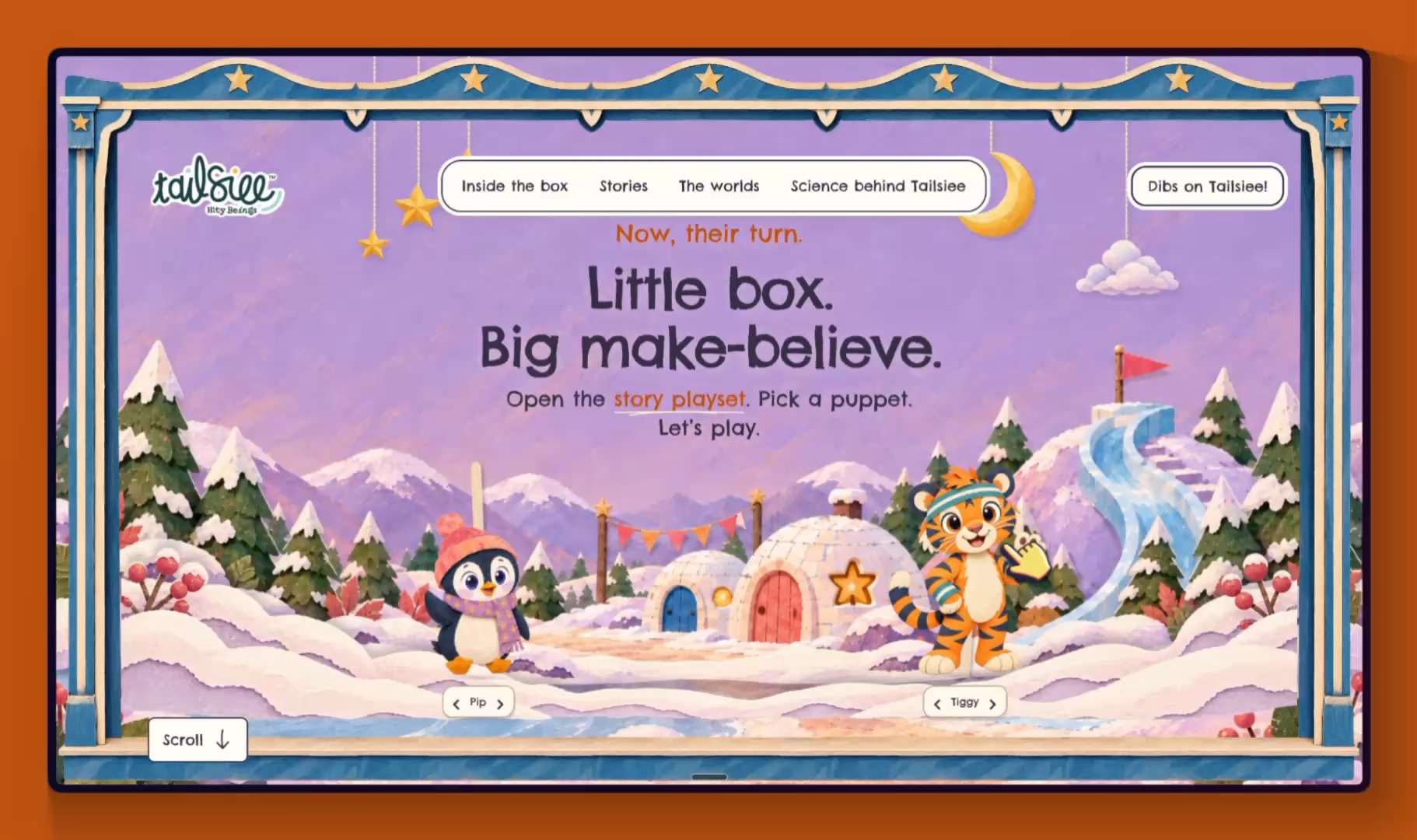
I wanted parents to get a feel for Tailsiee as they learnt what it was. I designed and built the website as a paper stage, introducing the carrier before inviting them to hear a story and move the puppets around themselves. Those moments give a small preview of the listening and play that come with the product. The website is built; the physical carrier has yet to launch, and the wider experience is still a concept.
What I owned
- Product strategy
- Shaping the product idea and its direction, with the founder’s support.
- Product collaboration
- Collaborating with an industrial designer to develop the syrup bottle carrier.
- Storytelling
- Character story arcs, audio-story development and the launch video.
- Website
- The puppetry-stage concept, interactive website, and code handoff.
01 / Where it started
A first-aid kit led us to the syrup bottle.
We initially imagined a first-aid kit specifically to care for children. That raised a question: what was particular to caring for toddlers and infants? Syrup medicine stood out, along with a practical problem: bottles leaking. We came up with a syrup bottle carrier.
The carrier addressed taking syrup bottles along. Research into medicine use broadened the focus to the routine around each dose. The proposition grew to include a story buddy who also takes medicine, with physical play extending the relationship beyond listening. The medicine itself stays unchanged.
Children’s first-aid kit
Leaking syrup bottles
Syrup bottle carrier
Research into medicine use
Carrier, stories & play
02 / Published research
Why look beyond carrying medicine?
29.6% of 815 children under 18 in an Indian outpatient study did not follow the prescribed antibiotic course or dosing schedule, according to caregiver interviews. More frequent doses and two or more additional medicines were associated with lower adherence. The challenge extends across a routine that a parent and child need to repeat.
India’s wider antimicrobial-resistance challenge adds context. An eClinicalMedicine study found that 83.1% of 349 adults screened before specialist endoscopy at a Hyderabad centre carried multidrug-resistant organisms, compared with 20.1% at the U.S. centre and 10.8% at the Dutch centre. WHO identifies misuse and overuse among several drivers of resistance. For Tailsiee, the design question is how to support children and parents through each prescribed dose.
03 / Stories & physical play
Stories for medicine time and beyond.
Studies suggest that storytelling can ease fear and anxiety in hospitalised children and that therapeutic play can improve acceptance of treatment. Parents have also reported fewer difficulties giving medicine after using a medicine-focused picture book.
For Tailsiee, the intention was to make medicine time feel shared through a familiar story character, then let children take that world into physical play.
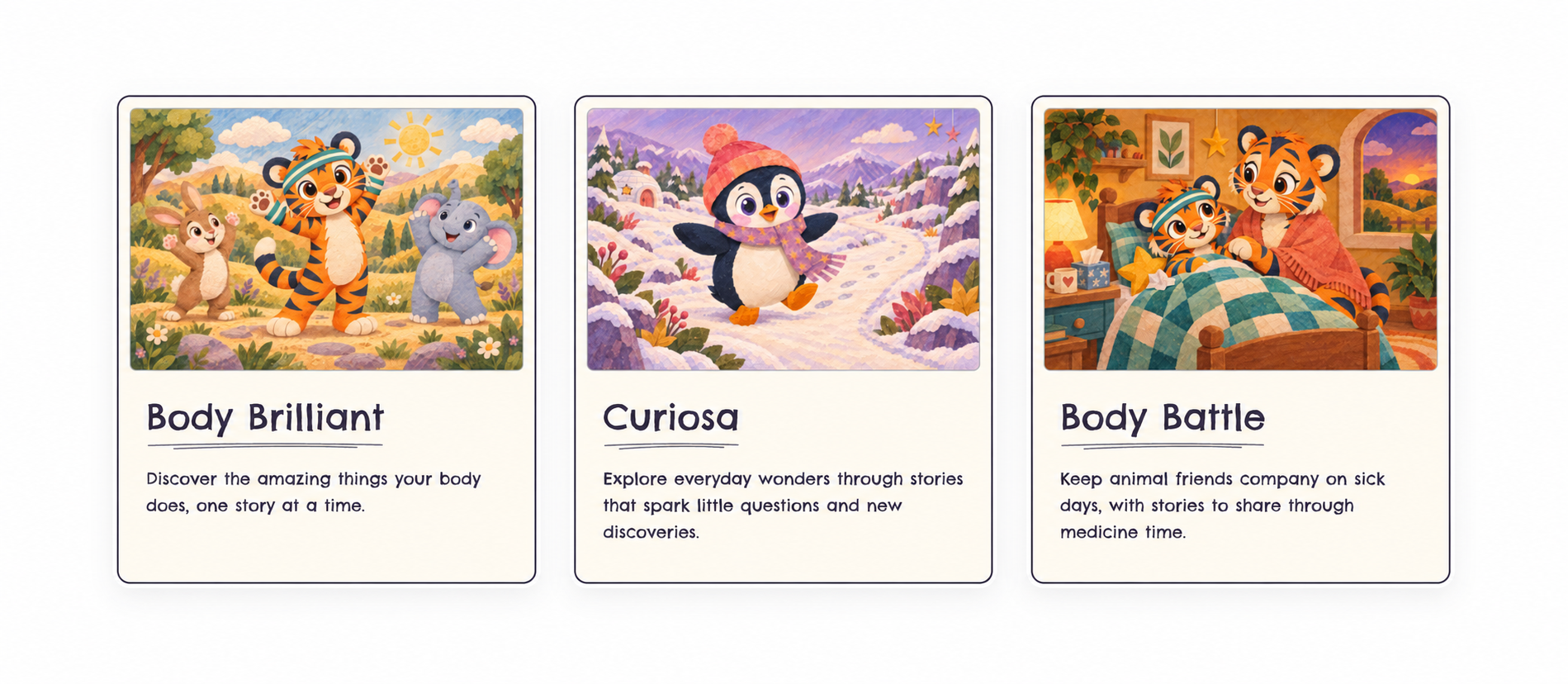 Up to 5 minutesUp to 5 minutes2–3 minutes
A buddy through medicine time
Tailsiee has three story modes: Body Battle, Body Brilliant and Curiosa. Body Battle gives the child a buddy who is also unwell and gradually gets better. Its brief episodes respect an unwell child’s limited patience and give the parent a short lead-in to a dose. The intended journey pairs each prescribed dose with a continuing story, with the buddy taking medicine before the child’s own dose.
Parent sets the routine
Medicine, dose count and days
Stories by dose
A continuing story across doses
Child hears the story
The buddy takes medicine
Child takes the medicine
With the parent’s help
The same buddy was intended to stay with the child after recovery. In Body Brilliant, the character would introduce how the body works and what food does for it. Curiosa would follow questions from its world, such as why penguins waddle, giving children new reasons to listen and play once the medicine routine ends.
Let children shape the story
Audio introduces a character and a world to imagine. The puppetry box gives children a way to shape that world themselves: moving the characters, retelling a scene or inventing what happens next with a grown-up.
04 / Website concept & build
The website as a stage.
The carrier is the primary product, so the opening begins with it on a bedside table. An audio preview follows, then the scene becomes a paper stage with movable puppets. Scrolling introduces the offer a part at a time, letting parents try the listening and play that sit around the bottle.
What comes with it
The stage gives a feel for Tailsiee; “Inside the box” makes the offer explicit. A persistent four-part selector keeps the carrier, audio stories, playset and DIY activities together while showing what each contributes.
The launch film
1 min 49 sec05 / The story worlds
Characters, worlds and learning.
The buddy needs a world the child can return to after sick days. The map makes the character the starting point: choosing an island reveals its personality and learning themes. This gives the familiar companion a place in the wider story library.
Elementarium
Elementarium, Hlty Beings’ existing IP, organises food, science and wellbeing as a periodic table of learning ideas. Here the starting point is a topic: parents can open an idea, read its explanation and follow a connection to a character world. Linking these routes keeps the learning attached to a companion and a setting.
06 / Reflection
What the website couldn’t tell us.
A story before each dose could make medicine time feel shared, or add another task for a parent caring for an unwell child. That is something the website cannot answer. I would have liked more testing with parents and children while the experience was still taking shape. The physical carrier has yet to launch, and the wider experience is still a concept.
Body Battle raises a more specific question: what happens when the buddy gets better before the child does? Its recovery arc was meant to offer companionship, but could stop reflecting the child’s experience. How the story responds to that mismatch remains unresolved.